
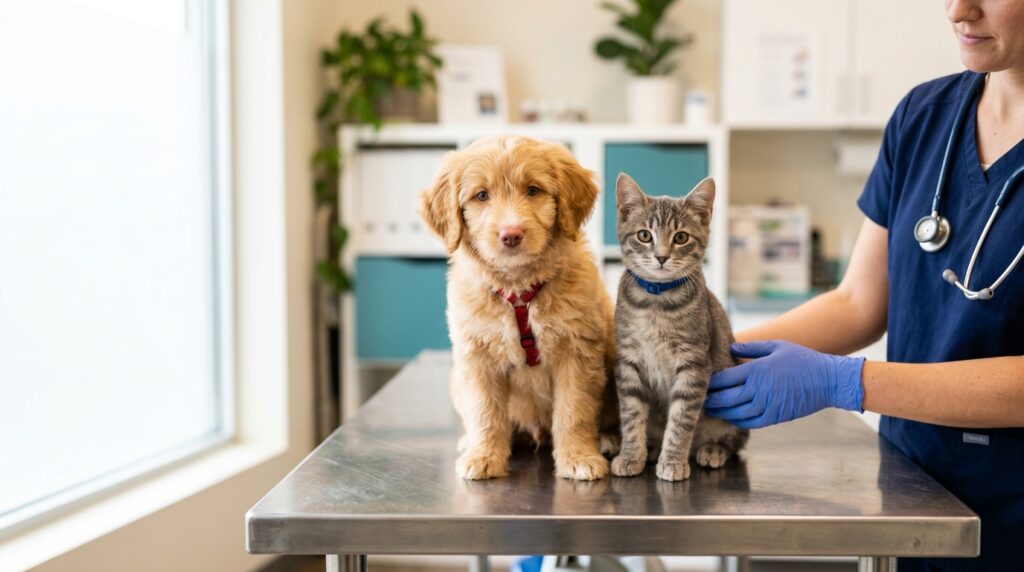
Bring home a new puppy or kitten and one of the first questions any vet near me will ask is when you plan to have them fixed. Most owners nod along, yet plenty leave the exam room unsure about the difference between spay and neuter, which surgery their pet actually needs, and when it should happen. This guide from the team at C.H. Veterinary Clinic in Fresno explains both procedures in plain language, compares them side by side, and covers timing, recovery, and what to look for in a spay and neuter clinic for your dog or cat.
What Is Spay Neuter? The Short Answer
“Spay neuter” is the everyday name for surgically sterilizing a pet so it can no longer reproduce. You will also hear “fixed,” “altered,” or “sterilized.” They all mean the same thing.
The two words describe two different surgeries:
- Spay: performed on female dogs and cats.
- Neuter: performed on male dogs and cats.
In veterinary records, “neutered” can technically describe any sterilized pet, but in daily use “spay” means girls and “neuter” means boys.
What Is the Difference Between Spay and Neuter?
The core difference is the sex of the pet, and that shapes the anatomy involved, the surgery time, and the recovery.
Spaying: Surgery for Female Pets
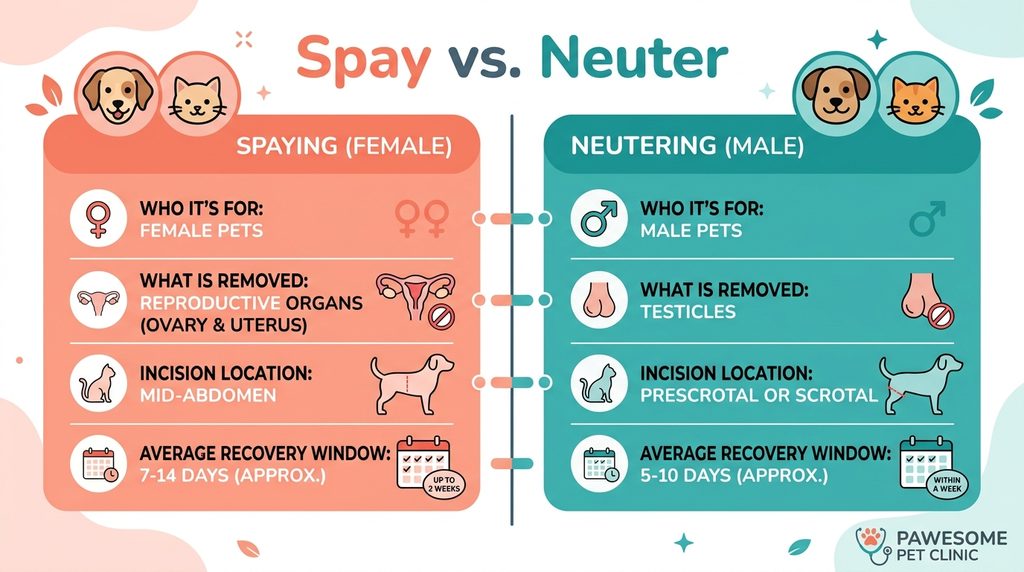
The clinical name for a spay is an ovariohysterectomy, which means removing the ovaries and the uterus. Some veterinarians perform an ovariectomy instead, which removes only the ovaries. Either way, the veterinarian makes an incision along the midline of the belly and works inside the abdomen.
Because it is internal, a spay is the more involved of the two surgeries. Afterward, your pet no longer goes into heat and cannot become pregnant.
Neutering: Surgery for Male Pets
A neuter, also called castration or orchiectomy, removes both testicles. In dogs, the veterinarian usually makes one small incision just in front of the scrotum. In cats, the procedure often uses two tiny incisions on the scrotum that are commonly left to heal without stitches.
A routine neuter does not open the abdomen. The exception is an undescended testicle (cryptorchidism), which can make the surgery closer to a spay in complexity.
Spay vs. Neuter at a Glance
| Factor | Spay | Neuter |
|---|---|---|
| Pet | Female dogs and cats | Male dogs and cats |
| Medical name | Ovariohysterectomy or ovariectomy | Orchiectomy (castration) |
| What is removed | Ovaries, and usually the uterus | Both testicles |
| Surgical approach | Abdominal incision | Small incision near or on the scrotum |
| Complexity | Higher, since it is internal | Lower in most cases |
| What it ends | Heat cycles and pregnancy | Ability to sire litters, most hormone-driven behavior |
| Key health benefit | Prevents uterine infection, lowers mammary tumor risk | Eliminates testicular cancer, lowers prostate disease risk |
| Activity restriction | Typically 10 to 14 days | Typically 10 to 14 days for dogs, often shorter for cats |
Which One Does Your Pet Need?
Your pet’s sex decides which surgery they get. The real decision is timing, based on species, breed, adult size, and health.
Timing for Dogs
For most small and medium dogs, around 6 months is a common starting point. Large and giant breeds often wait longer, because sex hormones affect when growth plates close.
The best evidence on this comes from a 2020 University of California, Davis study of 35 dog breeds. Small breeds showed no added joint risk tied to neutering age. Golden Retrievers, Labrador Retrievers, and German Shepherds did show higher joint disorder rates when neutered early, while Great Danes and Irish Wolfhounds showed no increase at any age.
There is no single right age for every dog. If you are searching for dog neutering near me for a large-breed puppy, share the breed and expected adult weight with your veterinarian.
Timing for Cats
Cats are more straightforward. The American Veterinary Medical Association supports spaying or neutering cats by 5 months of age. Female cats can come into heat earlier than owners expect, and intact males often start spraying urine. Even indoor cats benefit, since fixing them before these habits start is far easier than undoing them later.
Health and Behavior Benefits of Spaying and Neutering
Beyond preventing litters, a pet spay and neuter procedure protects against several serious health problems.
Benefits for Female Pets
Protection from pyometra. Pyometra is a life-threatening infection of the uterus that usually requires emergency surgery. Swedish insurance data summarized in a Veterinary Record study on pyometra showed that around 24 percent of intact female dogs had experienced pyometra by 10 years of age. Spaying removes that risk completely.
Lower mammary tumor risk. According to the ASPCA, breast tumors are malignant in about 50 percent of dogs and about 90 percent of cats. Spaying before the first heat cycle offers the most protection.
No more heat cycles, which means no bleeding, yowling, or male dogs at your fence.
Benefits for Male Pets
- No testicular cancer, since the testicles are removed.
- Lower risk of prostate enlargement and related prostate problems in dogs.
- Less roaming, which lowers the risk of traffic accidents, fights, and getting lost.
- Less marking and mounting in many dogs, and far less urine spraying in male cats.
What Spaying and Neutering Will Not Change
Your pet’s personality stays the same. Learned habits like leash pulling still need training, hormone-driven behaviors fade over a few weeks rather than overnight, and energy needs usually drop, so portions may need adjusting.
Risks and Trade-Offs to Discuss With Your Vet
Serious complications are uncommon, but not zero, so a good veterinarian will walk you through the trade-offs:
- Anesthesia risk. Low for healthy pets, and lowered further by screening bloodwork and careful monitoring.
- Weight gain. Manageable with adjusted portions and regular exercise.
- Urinary incontinence. Some spayed female dogs, particularly larger breeds, develop leaking later in life. It is usually treatable.
- Breed-specific risks. As the UC Davis research shows, early timing may raise joint or certain cancer risks in specific breeds.
- Alternative procedures. Ovary-sparing spays and vasectomies exist but are much less common. Ask your veterinarian whether they make sense for your pet.
Letting a female have one litter or one heat first offers no medical benefit and gives up some mammary tumor protection.
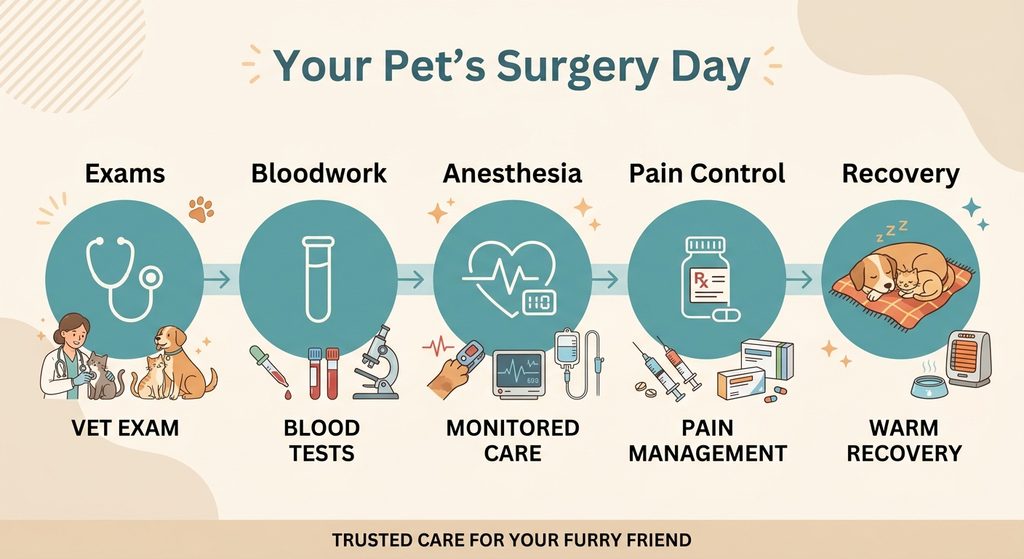
What a Spay or Neuter Day Looks Like at C.H. Veterinary Clinic
Every patient at our Fresno spay and neuter clinic follows the same careful path.
Step 1: Pre-surgical exam. Your veterinarian examines your pet and answers your questions.
Step 2: Screening before anesthesia. We run pre-anesthetic bloodwork in our own lab before every procedure. It is included, not an optional add-on, and helps catch hidden kidney or liver issues.
Step 3: Tailored anesthesia. The anesthesia protocol is matched to your pet’s age, breed, weight, and health status, with monitoring throughout the procedure.
Step 4: Pain management. Pain control starts before surgery, continues during it, and goes home with your pet as take-home medication.
Step 5: Monitored recovery. Your pet wakes up under supervision, and you leave with written aftercare instructions.
Procedures are performed by our veterinary team, including Dr. Charlene Hagus, DVM, who earned her veterinary degree at UC Davis and completed her internship and residency at Texas A&M University, and Dr. Hukampartap Singh, DVM, an ECFVG-certified veterinarian and AVMA member.
Spay and Neuter Recovery: Aftercare at Home
Most complications come from pets doing too much, too soon, or licking their incision. On the first night, expect grogginess, set up a calm space away from stairs, and feed only as your discharge instructions direct.
The Two-Week Recovery Plan
| Recovery Window | What to Do |
|---|---|
| Days 1 to 3 | Short leash walks for bathroom breaks only, keep the cone on, give pain medication on schedule |
| Days 4 to 7 | Check the incision daily for redness or swelling, no running, jumping, or rough play |
| Days 8 to 14 | Continue restricted activity, keep the incision dry with no bathing or swimming |
| After clearance | Return to normal play once your veterinarian confirms healing |
The cone is the most important tool here, since licking is the most common cause of complications.
When to Call the Vet
Call (559) 292-7393 right away if you notice:
- Swelling, discharge, or bleeding at the incision
- An incision that has opened
- Vomiting that does not stop
- Lethargy or loss of appetite that is not improving after the first day
If something seems off, our same day vet appointment options mean your pet can usually be checked quickly.
How to Choose a Spay and Neuter Clinic Near You in Fresno
Searching “spay neuter near me” brings up everything from full-service clinics to high-volume programs. Before you book with any neuter and spay clinic, ask:
- Is pre-anesthetic bloodwork part of every procedure?
- Who monitors anesthesia, and how?
- What pain medication does my pet get during surgery and at home?
- Will I receive written aftercare instructions?
- Who do I call if something looks wrong during recovery?
- Does my pet need any vaccines updated before surgery? If you have been looking for cat vaccinations near me or puppy shots, the pre-surgery visit is a convenient time to get caught up.
Clear answers to all six are a strong sign. Still comparing practices? Our guide to finding the best veterinarian near me in Fresno covers what else to look for.
Ready to Talk About Spaying or Neutering Your Pet?
Whether you have a new kitten, a large-breed puppy, or an older pet that was never fixed, our team will help you choose the right timing. Visit us at 2588 N Temperance Ave, Fresno, CA 93727, call (559) 292-7393, or use our online form to request a dog vet appointment or cat visit.
Frequently Asked Questions
-
What is the difference between spay and neuter in simple terms?
A spay is surgery for female pets that removes the ovaries and usually the uterus, so they cannot get pregnant or go into heat. A neuter is surgery for male pets that removes both testicles, so they cannot father litters. Spaying is an abdominal surgery and a bit more involved, while neutering is usually quicker. Both are routine procedures that prevent unplanned litters and lower the risk of several serious health problems in dogs and cats.
-
Which recovery is harder, spay or neuter?
Spay recovery usually takes a little more care because the surgery involves an abdominal incision. Most dogs need about 10 to 14 days of restricted activity after either procedure, while male cats often bounce back within a few days after a neuter. Regardless of the surgery, keep the cone on, prevent running and jumping, and check the incision every day. Your veterinarian will give you a recovery timeline tailored to your pet’s age, size, and health.
-
Can a dog or cat be spayed while in heat?
Yes, it is possible, but many veterinarians prefer to wait until the heat cycle ends. During heat, blood flow to the reproductive tract increases, which makes the surgery more delicate. Cats are often spayed while in heat without issue, while dogs are usually scheduled a few weeks after the cycle finishes. If your pet is in heat now, call your veterinarian to discuss timing and keep her safely away from intact males in the meantime.
-
Will neutering calm my dog down?
Neutering often reduces hormone-driven behaviors such as roaming, marking, mounting, and some aggression toward other male dogs. It does not change your dog’s core personality, energy level, or intelligence. Habits that are learned, like pulling on the leash or jumping on visitors, still need consistent training. Changes also happen gradually over several weeks as hormone levels drop. If you are hoping surgery will fix a behavior problem, mention it during the pre-surgical exam so your vet can set realistic expectations.
-
Is it too late to spay or neuter an older pet?
In most cases, no. Adult and senior pets can still benefit, especially females, since spaying prevents pyometra at any age. Older pets may carry slightly higher anesthesia risk, which is why pre-anesthetic bloodwork and a thorough exam are so important. Your veterinarian will check heart, kidney, and liver health before recommending surgery. Many pets adopted as adults are spayed or neutered safely and recover well with proper monitoring and pain control.
-
How do I find a trusted spay and neuter clinic near me in Fresno?
Start by looking for a clinic that includes pre-anesthetic bloodwork, monitors anesthesia throughout the procedure, provides pain medication for home, and gives written aftercare instructions. Read reviews, check the veterinarians’ credentials, and call with questions before booking. Fresno pet owners looking for a spay neuter near me option can reach C.H. Veterinary Clinic on N Temperance Ave at (559) 292-7393 to schedule a pre-surgical exam for their dog or cat.
Choosing to spay or neuter is one of the simplest decisions you can make for a longer, healthier life with your pet, and the right timing makes all the difference.